 |
SoDaRadio-12.2.0-cut_dependencies:6c82803
|
|
SoDaRadio-12.2.0-cut_dependencies:6c82803
|
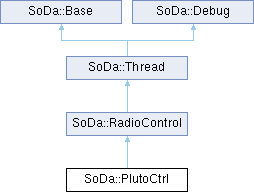
Concrete RadioControl for the ADALM-PLUTO SDR (AD9361 transceiver). More...
#include <PlutoCtrl.hxx>
Public Member Functions | |
| ~PlutoCtrl () | |
| RadioControlPtr | getSelfPtr () override |
| void | init () override |
| Set hardware sample rate before PlutoTX/PlutoRX create their DMA buffers. | |
| bool | isLOLocked (SoDa::RXTX rxtx) override |
| Methods that ALL radios must implement. | |
| double | setLOFreq (double freq, SoDa::RXTX rxtx) override |
| double | getLOFreq (SoDa::RXTX rxtx) override |
| Return the current LO (front end) oscillator setting for RX or TX chain. | |
| float | setRFGain (float gain, SoDa::RXTX rxtx) override |
| set tain on the RX or TX side | |
| void | setSampleRate (float rate, SoDa::RXTX rxtx) override |
| Set the RX or TX sample rate. | |
| float | getSampleRate (SoDa::RXTX rxtx) override |
| Get the current setting for the sample rate. | |
| std::string | getHardwareDescription () override |
| report the model number and any other interesting features (like freq range) to be displayed on the UI and such. | |
| std::vector< std::string > | listAntennas (SoDa::RXTX rxtx) override |
| report the antennas that are available. | |
| void | setAntenna (const std::string &ant, SoDa::RXTX rxtx) override |
| Set the antenna choice. | |
| std::string | getAntenna (SoDa::RXTX rxtx) override |
| Get the current selected antenna. | |
| bool | getTXEna () override |
| get the state of the TXEna bit | |
| bool | getTXRelayOn () override |
| get the state of the TX relay confirm bit | |
| void | setTXEna (bool enable, bool full_duplex) override |
| Enable or disable the transmit hardware chain, including the antenna relay and PA enable. | |
| Public Member Functions inherited from SoDa::RadioControl | |
| RadioControl (ParamsPtr params, const std::string &name) | |
| Constructor Build a RadioControl thread. | |
| void | run () final |
| start the thread | |
| void | subscribeToMailBoxes (const std::vector< MailBoxBasePtr > &mailboxes) |
| implement the subscription method | |
| Public Member Functions inherited from SoDa::Thread | |
| void | registerThread (SoDa::ThreadPtr me) |
| void | operator() () |
| void | start () |
| Execute the thread's run loop. | |
| void | join () |
| more properly "Wait for this thread to exit its run loop". | |
| void | execCommand (CommandPtr cmd) |
| Execute (dispatch) a message removed from the command stream to one of the basic Command handler functions. | |
| virtual void | shutDown () |
| optional method that performs cleanup – may not delete. | |
| void | sleep_ms (unsigned int milliseconds) |
| void | sleep_us (unsigned int microseconds) |
| uint32_t | getID () |
| Get the process/thread ID for this thread – helps with figuring out who caused a segfault. | |
| Public Member Functions inherited from SoDa::Base | |
| Base (const std::string &oname) | |
| The constructor – pass a name for the object. | |
| void | registerSelf (BasePtr ptr) |
| std::string & | getObjName () |
| get the name of this object | |
| BasePtr | findSoDaObject (const std::string &oname) |
| find a SoDa Object by name. | |
| double | getTime () |
| Get a time stamp in nS resolution that monotonically increases and that is very inexpensive (typically < 100nS). | |
| BasePtr | getSelfPtr () |
| get a pointer to myself. | |
| Public Member Functions inherited from SoDa::Debug | |
| Debug (std::string _unit_name=std::string("UNKNOWN")) | |
| Debug (const char *_unit_name_cstr) | |
| Debug (unsigned int _debug_level, std::string _unit_name=std::string("UNKNOWN")) | |
| Debug (unsigned int _debug_level, const char *_unit_name_cstr) | |
| void | debugMsg (const std::string &msg, unsigned int threshold=1) |
| void | debugMsg (const SoDa::Format &fmt, unsigned int threshold=1) |
| void | debugMsg (const char *msg, unsigned int threshold=1) |
| void | setDebugLevel (unsigned int v) |
| unsigned int | getDebugLevel () |
Static Public Member Functions | |
| static PlutoCtrlPtr | make (ParamsPtr params) |
| Static Public Member Functions inherited from SoDa::Debug | |
| static void | setDefaultLevel (unsigned int v) |
| static unsigned int | getDefaultLevel () |
| static void | setGlobalLevel (unsigned int v) |
| static unsigned int | getGlobalLevel () |
Protected Member Functions | |
| PlutoCtrl (ParamsPtr params) | |
| Protected Member Functions inherited from SoDa::RadioControl | |
| virtual void | execCommand (CommandPtr cmd) final |
| Parse an incoming command and dispatch. | |
| virtual void | execGetCommand (CommandPtr cmd) final |
| Parse an incoming GET command and dispatch. | |
| void | execSetCommand (CommandPtr cmd) final |
| Parse an incoming SET command and dispatch. | |
| void | execRepCommand (CommandPtr cmd) final |
| Parse an incoming REPort command and dispatch. | |
| double | getTime () |
| get the number of seconds since the "Epoch" | |
| void | setFreq (double freq, SoDa::RXTX rxtx) |
| Set the recieve or transmit frequency to 'freq' This includes setting the PLL front end synthesizer, the FPGA resident digital synthesizer (if it exists) and the RX baseband or TX baseband oscillator. | |
| void | setTXRXMode (Command::RxTxState rxtxst, bool full_duplex) |
| Initiate the actions that will turn on the transmitter and (optionally) disable the receiver. | |
| virtual bool | setClockSource (Command::ClockSource src) |
| Some radios support multiple choices for the main reference clock source. | |
| virtual Command::ClockSource | getClockSource () |
| Some radios support multiple choices for the main reference clock source. | |
| double | findGoodRXLO (double freq, double cur_lo_freq) |
| see setFreq - this is a helper to find a good LO frequency that puts the IF in a range that is convenient for the spectrum display. | |
| Protected Member Functions inherited from SoDa::Thread | |
| Thread (const std::string &oname, const std::string &version=std::string("12.2.0")) | |
| make the thread object. | |
| Protected Member Functions inherited from SoDa::Debug | |
| std::string | curDateTime () |
Private Member Functions | |
| void | writeHWTXGain (double gain_db) |
| Write TX hardware gain (dB, range TX_GAIN_MIN..0) to IIO, clamping first. | |
| void | writeHWRXGain (double gain_db) |
| Write RX hardware gain (dB, range 0..RX_GAIN_MAX) to IIO, clamping first. | |
Private Attributes | |
| iio_context * | ctx |
| IIO context (network, USB, or local) | |
| iio_device * | phy |
| ad9361-phy control device | |
| iio_channel * | rx_lo_chan |
| altvoltage0: RX PLL oscillator | |
| iio_channel * | tx_lo_chan |
| altvoltage1: TX PLL oscillator | |
| iio_channel * | rx_phy_chan |
| voltage0 (input direction): RX path config | |
| iio_channel * | tx_phy_chan |
| voltage0 (output direction): TX path config | |
| double | rx_lo_freq |
| last RX LO written to hardware (Hz) | |
| double | tx_lo_freq |
| last TX LO written to hardware (Hz) | |
| float | rx_samp_rate_hw |
| RX sample rate read back from hardware. | |
| float | tx_samp_rate_hw |
| TX sample rate read back from hardware. | |
| std::string | rx_antenna_name |
| std::string | tx_antenna_name |
| std::string | hw_description |
| cached string for getHardwareDescription() | |
| std::weak_ptr< PlutoCtrl > | self |
Static Private Attributes | |
| static constexpr double | RX_GAIN_MAX = 73.0 |
| dB maximum RX hardware gain | |
| static constexpr double | TX_GAIN_MIN = -89.75 |
| dB most-negative TX gain (= max atten) | |
| static constexpr double | FREQ_MIN = 70.0e6 |
| Hz (software-extended lower limit) | |
| static constexpr double | FREQ_MAX = 6.0e9 |
| Hz (software-extended upper limit) | |
| static constexpr float | PLUTO_SAMPLE_RATE = 2500000.0f |
Additional Inherited Members | |
| Static Public Attributes inherited from SoDa::Debug | |
| static std::mutex | debug_msg_mutex |
| Protected Attributes inherited from SoDa::RadioControl | |
| ParamsPtr | params |
| CmdMBoxPtr | cmd_stream |
| command stream channel | |
| CmdMBox::Subscription | cmd_subs |
| subscriber ID for this thread's connection to the command channel | |
| double | first_gettime |
| timestamps are relative to the first timestamp. | |
| double | rx_rf_gain |
| rf gain for RX front end amp/attenuator | |
| double | tx_rf_gain |
| rf gain for final TX amp | |
| bool | tx_on |
| if true, we are transmitting. | |
| double | cur_rx_lo_freq |
| The current receiver LO frequency. | |
| double | cur_rx_if_freq |
| difference between rx | |
| double | cur_tx_lo_freq |
| The current requested transmitter LO frequency. | |
| double | cur_tx_if_freq |
| the TX LO frequency reported by the RadioTX front end. | |
| double | tx_samp_rate |
| sample rate to TX chain. | |
| std::string | tx_ant |
| TX antenna choice (usually has to be TX or TX/RX1? | |
| std::string | motherboard_name |
| The model name of the radio. | |
| bool | tvrt_lo_capable |
| if true, this unit can implement a local transverter oscillator. | |
| bool | tvrt_lo_mode |
| if true, set the transmit frequency, with some knowledge of the tvrt LO. | |
| double | tvrt_lo_gain |
| output power for the second transmit channel (used for transverter LO) | |
| double | tvrt_lo_freq |
| the frequency of the second transmit channel oscillator | |
| double | tvrt_lo_fe_freq |
| the frequency of the second transmit channel front-end oscillator | |
| bool | debug_mode |
| print stuff when we are in debug mode | |
| Protected Attributes inherited from SoDa::Thread | |
| std::weak_ptr< Thread > | self |
| A pointer to ourself. | |
| Protected Attributes inherited from SoDa::Debug | |
| std::string | unit_name |
| the name of the unit reporting status | |
| unsigned int | debug_level |
| the debug level (threshold) for messages | |
| Static Protected Attributes inherited from SoDa::RadioControl | |
| static const double | tx_freq_rxmode_offset |
| tx offset when in RX mode | |
| Static Protected Attributes inherited from SoDa::Debug | |
| static unsigned int | default_debug_level |
| static unsigned int | global_debug_level |
Concrete RadioControl for the ADALM-PLUTO SDR (AD9361 transceiver).
All frequency, gain, and sample-rate commands arrive on the command stream and are dispatched by RadioControl::run(). This class provides the hardware-specific implementations of those virtual methods.
TX/RX switching is handled by asserting maximum TX attenuation when the transmitter is disabled — the Pluto has no external relay GPIO.
Definition at line 78 of file PlutoCtrl.hxx.
|
protected |
References SoDa::RadioControl::params.
Referenced by make().
| SoDa::PlutoCtrl::~PlutoCtrl | ( | ) |
|
overridevirtual |
Get the current selected antenna.
| rxtx | rx/tx selection |
Implements SoDa::RadioControl.
|
overridevirtual |
report the model number and any other interesting features (like freq range) to be displayed on the UI and such.
Implements SoDa::RadioControl.
|
overridevirtual |
Return the current LO (front end) oscillator setting for RX or TX chain.
| rxtx | select receiver or transmitter |
Implements SoDa::RadioControl.
|
overridevirtual |
Get the current setting for the sample rate.
| rxtx | choose RX chain or TX chain |
Implements SoDa::RadioControl.
|
inlineoverridevirtual |
|
overridevirtual |
get the state of the TXEna bit
Implements SoDa::RadioControl.
|
overridevirtual |
get the state of the TX relay confirm bit
Implements SoDa::RadioControl.
|
overridevirtual |
Set hardware sample rate before PlutoTX/PlutoRX create their DMA buffers.
iio_buffer_push() silently fails if the DMA buffer is created before the ad9361-phy sampling_frequency attribute is written. This override ensures the rate is written during PlutoRadio::init() (ctrl→rx→tx order) so that PlutoTX::init() sees a correctly configured DMA engine.
Reimplemented from SoDa::RadioControl.
|
overridevirtual |
Methods that ALL radios must implement.
is the identified (rx or tx) front-end LO locked? If not, set the tuning frequency to "the right thing"
| rxtx | RX, TX |
Implements SoDa::RadioControl.
|
overridevirtual |
report the antennas that are available.
we'll use this to let the GUI know what the choices are.
| rxtx | select which port RX, or TX |
Implements SoDa::RadioControl.
|
inlinestatic |
Definition at line 85 of file PlutoCtrl.hxx.
References PlutoCtrl(), and SoDa::RadioControl::params.
|
overridevirtual |
Set the antenna choice.
Use "ant" if it is in the list of alternatives. Otherwise, choose the first alternative.
| ant | the requested antenna |
| rxtx | rx/tx selection |
Implements SoDa::RadioControl.
|
overridevirtual |
   @brief Set the front-end (LO + DDS) frequency to 'freq'
   This includes setting the PLL front end synthesizer
   as well as the FPGA resident digital synthesizer.

   @param freq targeto frequency (analog LO and DDS in the FPGA)
   @param rxtx select receiver or transmitter

   @return The actual LO frequency.

   The actual LO frequency may differ from the requested frequency by a small
   margin. Some radios may have a tuning step that is more than a few Hz. In this
   case we adjust the LO in the RX and TX objects. (This may be a bigger deal for the
   TX object as we like to do all the modulation there at baseband and assume the
   hardware takes care of the carrier frequency.

   Typically, the call for a receive request would look like this:

   actual_lo_freq = setLOFreq(144.215e6, SoDa::RX)

   If the target LO can tune in 20 kHz intervals, the actual LO would be 144.100e6 and
   the if_freq would be 115e3 Hz. This would allow a "clean" window from 144.115 Mhz to
g * 144.325 MHz in the spectrogram display. The LO would need to be changed if the next frequency was greater than 144.240 or less than 144.205 (I think)
On the transmit side, the offset may be dictated by the frequency stepping increment in the front-end LO.
To keep everything civilized, setLOFreq should never be called by any other agent than the RadioControl object. (Not even its sub-classes.)
Implements SoDa::RadioControl.
|
overridevirtual |
set tain on the RX or TX side
The radio implementation is responsible for mapping the gain to the appropriate control settings.
The range for gain is -30 to 0 in dB. 0 is maximum power or maximum front end RX gain. The device may support a more limited range, say -15 to 0 dB. In this case, any gain value less than -15 is treated as -15. For devices that support a greater range, the supported range is still -30 to 0.
| gain | gain - if not in range, we'll pick something good |
| rxtx | receive or transmit? |
Implements SoDa::RadioControl.
|
overridevirtual |
Set the RX or TX sample rate.
| rate | sample rate (in samples/sec) |
| rxtx | choose RX chain or TX chain |
Implements SoDa::RadioControl.
|
overridevirtual |
Enable or disable the transmit hardware chain, including the antenna relay and PA enable.
In half-duplex mode the RX chain should also be muted.
| tx_on | if true, enable the TX hardware; if false, disable it. |
| full_duplex | if true, leave the RX chain active while transmitting. |
Implements SoDa::RadioControl.
|
private |
Write RX hardware gain (dB, range 0..RX_GAIN_MAX) to IIO, clamping first.
|
private |
Write TX hardware gain (dB, range TX_GAIN_MIN..0) to IIO, clamping first.
|
private |
IIO context (network, USB, or local)
Definition at line 130 of file PlutoCtrl.hxx.
|
staticconstexprprivate |
Hz (software-extended upper limit)
Definition at line 153 of file PlutoCtrl.hxx.
|
staticconstexprprivate |
Hz (software-extended lower limit)
Definition at line 152 of file PlutoCtrl.hxx.
|
private |
cached string for getHardwareDescription()
Definition at line 147 of file PlutoCtrl.hxx.
|
private |
ad9361-phy control device
Definition at line 131 of file PlutoCtrl.hxx.
|
staticconstexprprivate |
Definition at line 157 of file PlutoCtrl.hxx.
|
private |
Definition at line 144 of file PlutoCtrl.hxx.
|
staticconstexprprivate |
dB maximum RX hardware gain
Definition at line 150 of file PlutoCtrl.hxx.
|
private |
altvoltage0: RX PLL oscillator
Definition at line 133 of file PlutoCtrl.hxx.
|
private |
last RX LO written to hardware (Hz)
Definition at line 139 of file PlutoCtrl.hxx.
|
private |
voltage0 (input direction): RX path config
Definition at line 135 of file PlutoCtrl.hxx.
|
private |
RX sample rate read back from hardware.
Definition at line 141 of file PlutoCtrl.hxx.
|
private |
Definition at line 159 of file PlutoCtrl.hxx.
Referenced by getSelfPtr().
|
private |
Definition at line 145 of file PlutoCtrl.hxx.
|
staticconstexprprivate |
dB most-negative TX gain (= max atten)
Definition at line 151 of file PlutoCtrl.hxx.
|
private |
altvoltage1: TX PLL oscillator
Definition at line 134 of file PlutoCtrl.hxx.
|
private |
last TX LO written to hardware (Hz)
Definition at line 140 of file PlutoCtrl.hxx.
|
private |
voltage0 (output direction): TX path config
Definition at line 136 of file PlutoCtrl.hxx.
|
private |
TX sample rate read back from hardware.
Definition at line 142 of file PlutoCtrl.hxx.
 1.14.0